
Estonia Citizenship by Investment: Residency Routes and Naturalization Timeline

I used their services for assistance with business-related immigration documents. Everything was handled professionally and communication was consistent. They were detail-oriented with paperwork, which honestly helped reduce a lot of stress. Overall, a solid experience without any major issues
Read on TrustPilot
I had a consultation with Bimaris Law Firm regarding immigration and tax questions connected to relocation. They were helpful and seemed knowledgeable in both areas, which saved me time looking for separate specialists. I appreciated the calm and professional approach. The whole experience felt smooth and well managed.
Read on TrustPilot
I've worked with Taras from Bimaris (formerly Intermarium) a few times now over the past few years. As a Canadian citizen, they handled my temporary residence permit on the basis of employment at my already-registered LLC. Everything was successfully handled in 2026, then in 2024. Recommended!
Read on TrustPilot
Working with the team was very easy. They were quick to respond to our questions and needs.
Read on TrustPilot
As in any country, negotiating immigration bureaucracy can be difficult. I am glad I used the services of Bimaris as they were professional and very supportive, advising me at every stage and managing the paperwork. Today, they accompanied me to the Immigration centre to ensure all went smoothly. I strongly recommend them to anyone looking for visa and immigration services in Ukraine.
Read on TrustPilot
I was supported throughout several stages of my immigration process, and they were always happy to provide initial consultation and costing for services without charge. I cannot fault my experience with them
Read on TrustPilot
Professional, reliable and reasonably priced. I would recommend them to my friends or clients if they need legal services in Ukraine.
Read on TrustPilotAsk ten global entrepreneurs where they would launch a new EU business today, and five will answer “Estonia.” The numbers back the sentiment: more than 41,000 foreign-owned companies operate from Tallinn or Tartu, and 100 percent of routine government interactions, from paying VAT to signing contracts, can be completed online with a digital ID. Still, digital efficiency does not mean shortcuts to a passport. Estonia guards its nationality with Nordic seriousness, so every applicant must understand the long game that turns a residence permit into eventual citizenship.
Can You Get Estonian Citizenship Through Investment?
When Bimaris attorneys first sit down with a client, the most common opening line is: “I read that Malta used to sell EU passports - can Estonia do something similar?” The honest reply is “no.” Estonia does not sell citizenship. Instead, investment unlocks residency rights that, after years of compliance and integration, allow you to apply for naturalization.
The topic sharpened in April 2025 when the EU Court of Justice ruled that direct-sale passports unlawfully "commercialize" EU citizenship, breaching sincere cooperation. Malta immediately froze its Individual Investor Programme. Estonia, which never introduced an Estonian citizenship by investment program in the first place, found its conservative approach vindicated.
So why does the internet still overflow with ads promising an Estonia passport by investment in twelve months? Mostly recycled content. Under Estonian law, real estate ownership confers no residency rights, and donations to state funds buy you precisely zero immigration benefits. Anyone promising otherwise is either misinformed or misleading.
Estonia’s Approach to Citizenship
Estonia has one of the clearest, most codified nationality regimes in Europe. Everything revolves around the Kodakondsuse Seadus (Citizenship Act), originally enacted in 1995 and updated multiple times, most recently in July 2025. The Act elevates three pillars - residency, language, and loyalty - to non-negotiable status.
Holding an Estonian temporary residence permit is therefore step one. The permit can be granted for work, study, or, as explored later in this article, investment-related business activity. Maintain that permit, switch to permanent status after five years, pass the required exams, and only then may you file the naturalization petition.
Citizenship rules under Estonian law
The rules read drily on paper, yet every bullet has real-world implications:
- 1Length of residence. Eight years legal stay, the final five under permanent-resident status.
- 2Age threshold. 15 years to lodge your own application; younger children are included in parents’ files.
- 3Income proof. Officers look for tax returns or dividends that match at least the Estonian minimum wage plus 20 percent for each dependent. That number is indexed annually (€946 per month from April 2026).
- 4Criminality bar. Even a suspended sentence abroad can disqualify you; Estonia follows the Schengen Information System closely.
- 5Security oath. Successful applicants must swear allegiance to the Estonian constitutional order in person at a police office; the ceremony is brief but symbolic.
Missing one condition derails the bid. For example, a well-known crypto founder failed the civics test twice and had to wait twelve months before retaking it, pushing his naturalization into year nine. Those pursuing Estonia citizenship by investment routes need a time buffer for such hiccups.
Language and integration requirements
Mastering Estonian sits at the core of integration. The B1 exam has four components: listening, reading, writing and speaking. State data shows a robust 62 percent pass rate, thanks to free municipal classes and digital platforms. Realistically, plan 400-600 study hours. Many investor families hire private tutors who split lessons between adults and children to keep everyone on the same linguistic path.
Integration extends beyond grammar. Officers often ask how you participate in local life - sports clubs, parent committees, charity work. Volunteer activity is not codified as a requirement, but anecdotal evidence suggests it creates a favorable impression. Simply paying taxes is rarely enough to feel “genuinely linked” to Estonia.
Dual citizenship considerations
Estonia’s single-citizenship stance is among Europe’s strictest. Article 1 of the Citizenship Act bars dual nationality for naturalized adults, and courts have consistently upheld the rule even when applicants argue hardship.
Children born with dual citizenship may hold both passports until they turn 18 but must renounce one within three years of reaching adulthood - by age 21 at the latest. Investors eyeing citizenship by investment Estonia thus need advanced tax planning: renouncing one passport may trigger exit taxation or inheritance complications in the former country. Engage tax counsel early, preferably before your first residence-permit filing, to avoid a last-minute scramble.
Main Routes to Estonian Citizenship
Long-term, every legal path converges on one destination: the permanent residence permit in Estonia. Investors frequently assume that the way to nationality is a straight line. In truth, Estonia offers three distinct “on-ramps,” each with its own documentation rhythm. Understanding them prevents you from wasting years on an ineligible category.
Naturalization
This is the road that nearly every foreign entrepreneur must travel. Once you hold a permanent residence permit, clock five additional years in-country, keep a clean police record, pass language and civics exams, and swear allegiance, you may submit your application. Processing usually takes four to six months, though complex foreign-document checks can stretch the window. Compliance missteps like late tax filings and unexplained absences of 120 days can reset the residential clock, so schedule quarterly reviews with your counsel.
Citizenship by descent
Many readers dismiss this route too quickly. Estonia applies the principle of ius sanguinis: if a parent, grandparent, or even great-grandparent held Estonian citizenship as of June 1940, you may qualify automatically. For example, a client bypassed the eight-year residency requirement entirely by proving a grandparent held Estonian citizenship before June 1940. Unearthing 1939 church census data via the National Archives confirmed citizenship by descent - proof that paperwork sometimes beats capital when aiming for Estonia passport by investment equivalence.
Citizenship through marriage
Marrying an Estonian citizen does not create a fast track; you still need eight years of residence, five of those as a permanent resident. However, spousal support helps with integration - daily Estonian at home, family ties, and a built-in social circle. Couples living abroad may also count cohabitation time under EU family-reunion rules, shaving one to two years off physical stay once they relocate to Estonia.
Residency Options for Investors and Entrepreneurs
Most applicants who type “Estonia citizenship by investment program” into Google eventually land in one of four business-residence categories. Picking the right one affects not only capital layout but also visa speed, family inclusion, and tax posture.
Business-based residence permit
The classic route suits owners of export-oriented trading firms, software consultancies, or light-manufacturing entities. The legal requirement is an equity or fixed-asset contribution of €65,000 - the number printed in law. But officers look behind the balance sheet. A €65k injection that immediately sits idle in a bank account can raise questions. Instead, invest the money in R&D staff, equipment or market expansion that matches your business plan.
Speaking of business plans, the Police and Border Guard Board has tightened formal expectations since mid-2024. The plan must cover at least three fiscal years, include a SWOT analysis, and outline monthly liquidity projections. A vague ten-page narrative once worked; now expect to submit 25-30 pages of granular financials. Companies verified under company formation in Estonia services typically clear this hurdle because accountants structure the plan to match Estonian chart-of-accounts conventions.
Startup Visa pathway
Early-stage tech founders love the startup visa in Estonia because this country judges ideas, not bank balances. Still, “no capital requirement” does not equal a free pass. The Startup Committee assesses four parameters: innovation, scalability, global market potential, and team competence. The Startup Committee assesses applications strictly on innovation and global scalability, explicitly rejecting traditional, non-scalable e-commerce models. Craft your pitch deck like you would for a seed investor.
Once approved, you receive a one-year D-visa to settle and assemble operations, extendable by six months. After traction, usually €200k annualized revenue or credible VC investment, you convert to a five-year temporary residence permit. For many founders, this option resembles an implicit Estonia citizenship by investment play: sweat equity today equals long-term residency and, later, nationality.
Major investor residence permit
For family offices or PE principals who value time over incremental growth, the €1 million major-investor route remains the speediest: decisions within 60 days, permits valid for five years out of the gate. Statistically, fewer than 50 such permits are issued each year, but rejection risk is low when capital genuinely benefits the Estonian economy. Qualifying investments include venture funds with at least 51 percent Estonian target allocation, direct acquisition of controlling stakes in industrial firms, or greenfield projects that create ten or more local jobs.
Self-employed and sole trader route
Consultants, Amazon FBA sellers, or niche artisans often balk at the €65k threshold. Estonia accommodates them via the FIE framework: invest €16,000 into equipment or working capital and submit a scaled-down business plan. The plan still needs revenue projections, but officers accept client pre-contracts or letters of intent as proof. While the FIE path seems “cheap,” remember it also caps liability on your personal assets differently from an OÜ, so consult a lawyer before picking your entity form.
Investment Requirements for Business Applicants
Understanding capital thresholds is vital, but applicants often miss softer metrics: job creation, export revenue, and tax contribution. Officers score each application holistically, so align your strategy with quantifiable KPIs.
To visualize key criteria, the following table summarizes thresholds and recommended best-practice benchmarks.
| Route | Statutory Capital Minimum | Recommended Annual Turnover by Year 3 | Typical Processing Time | Family Inclusion Allowed |
|---|---|---|---|---|
| OÜ Business Permit | €65k | €200k–€400k | 8–12 weeks | Yes |
| Startup Visa → TRP | None (innovation test) | €250k revenue or €250k VC raised | 4–8 weeks | Yes |
| Major Investor | €1m | €1m+ (assets under mgmt) | ≤8 weeks | Yes |
| FIE / Sole Trader | €16k | €80k–€120k | 10–14 weeks | Spouse/children |
Exceeding recommended turnover is not compulsory, but historical approvals show companies meeting these marks rarely face renewal friction. Achieving them also makes your eventual citizenship by investment in Estonia stronger, demonstrating genuine economic integration.
Conditions for Sole Proprietors
The FIE framework deserves extra detail because many online summaries oversimplify it. When you register as a sole trader, your personal ID number becomes the company code, making you personally liable for debts. Immigration officers thus examine whether you retained enough capital for contingencies. A graphic designer may declare a €16k Mac-based studio, but if half the budget went into a leased BMW, expect probing questions.
- Business plan standards. Shorter than an OÜ’s but must still include market research. Officers like to see at least two B2B contracts or five recurring B2C customers.
- Tax treatment. FIEs pay social tax on net profit, not distributions, which can be higher than the OÜ dividend pathway. Factor this into your financial modeling.
- Renewal audits. Sole traders undergo extra scrutiny at the three-year mark; inability to show operating profit triggers permit revocation.
The Estonian Tax and Customs Board strictly prohibits deducting personal costs from business income. Keep separate accounts, even if not legally required, and hire a bookkeeper familiar with Estonian e-invoicing.
Estonia Golden Visa: Is It Available?
Press releases sometimes use “golden visa” interchangeably with investment residence, yet Estonia has never branded its regime this way. The government views golden-visa branding as tainted by scandals in other EU countries. Consequently, search results for “Estonia golden visa” mostly describe the major investor permit we already dissected. The practical advice: if your relocation pitch hinges on passive rental income or government-bond holdings, look elsewhere. If you are prepared to steer an Estonian enterprise, the major-investor track is effectively your Estonia citizenship by investment program just under a different name.
The absence of a branded golden visa has an upside. While Portugal, Greece, and Spain have increased real-estate thresholds or outright banned property routes, Estonia’s legislation remains stable. Predictability counts when your family ties an eight-year citizenship run to a single jurisdiction.
General Eligibility Criteria
Capital alone is not enough. Consider the non-financial gatekeepers:
Applicants must hold a clean criminal record from every country of residence for the previous five years, translated and apostilled. Estonia participates in the Schengen Information System, so undeclared infractions surface quickly.
Valid health insurance is mandatory until you join the Estonian Health Insurance Fund, which occurs after registering employment or paying social tax for a minimum period. Family offices sometimes forget to insure dependent parents; officers treat that omission as grounds for refusal.
These gatekeepers strictly control approval quality: first-time business residence permits dropped 33.8 percent in 2025. That confirms officers expect highly polished files, explicitly rejecting traditional or purely idea-stage applications. That suggests applicants are getting savvier, but also that officers expect more polished files.
Benefits of Estonian Citizenship
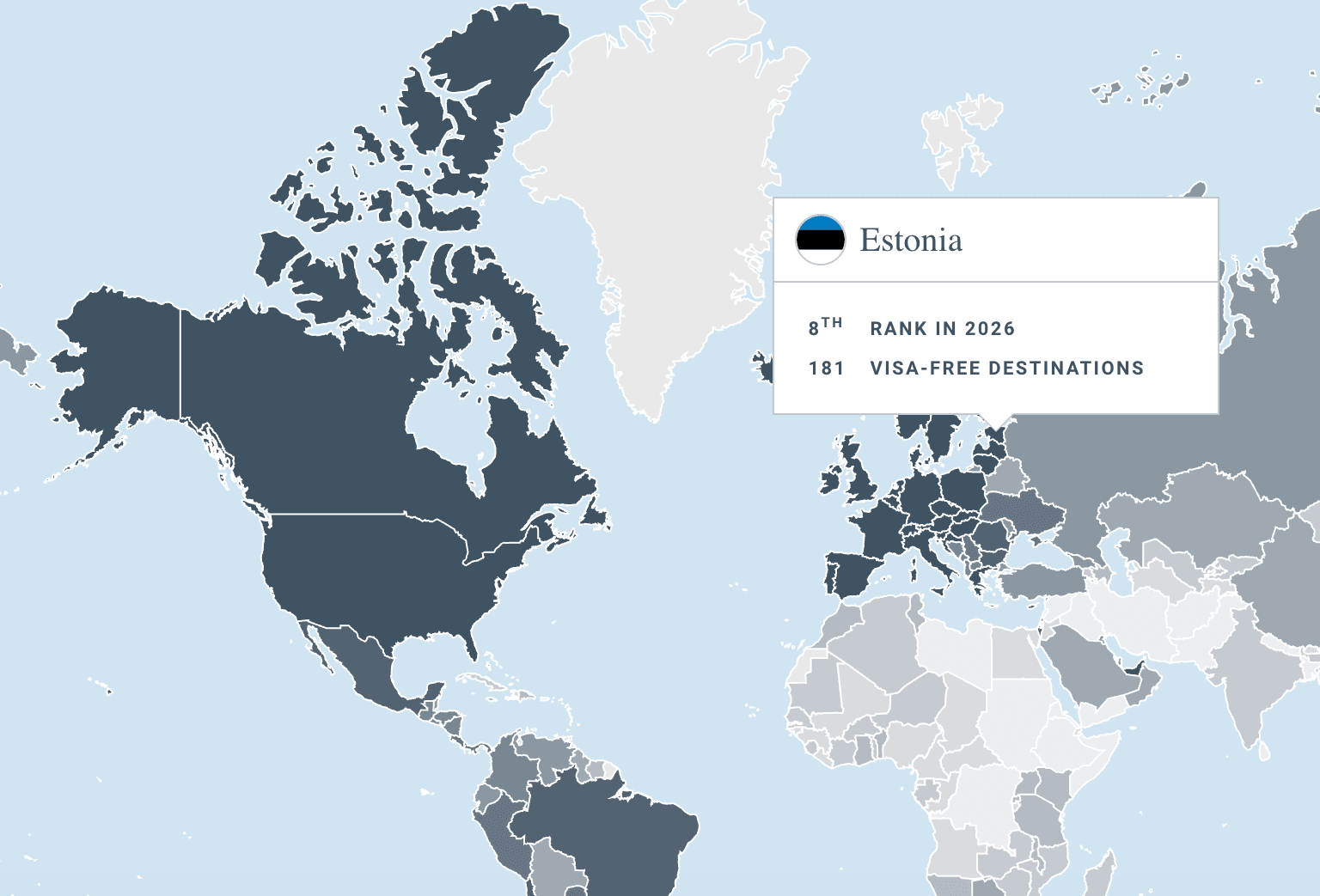
For the strategic investor, the reward side of the ledger is equally important. As of 2026, Estonian passports are ranked 8th in the Henley Passport Index, with visa-free access to 181 destinations. Business travel becomes frictionless: no ESTA forms for the United States, no e-visas for Japan, no invitation letters for Singapore.
Inside the EU, freedom of establishment allows you to register a second company in Berlin or Barcelona without work-permit bureaucracy. In family contexts, children pay local tuition rates at universities across the European Economic Area, often a €10,000 per year saving compared with non-EU students.
From a fiscal angle, Estonia’s famous 0 percent corporate tax on reinvested profit lets founders compound earnings until they decide to distribute dividends. Couple that with online reporting, and many clients reclaim 100-150 work hours annually - time they reinvest in product development or family. Not many jurisdictions simultaneously offer robust travel freedom, EU market access, and world-leading digital governance. That triad explains why Estonia passport by investment remains a high-intent search phrase despite Estonia’s long naturalization timetable.
What Happens After Moving to Estonia?
Year One feels exhilarating and daunting. You land at Lennart Meri Airport, collect your TRP card, and begin “life administration” tasks:
- 1Register your residential address; the state portal confirms within minutes.
- 2Open a bank account - LHV and Coop are investor-friendly; Swedbank remains cautious toward crypto revenue.
- 3Enroll children in school. International schools require early reservation; public schools guarantee placement but may limit English-language slots.
- 4Select a family doctor (not automatic) via the e-Patient portal.
- 5File your first tax return - yes, even partial-year residents file.
Completing these items within the first 60 days prevents bureaucratic snowballs later. The Estonian Population Register links every service to your address; fail to update it after a move, and you can miss critical government notices.
In Years Two and Three, integration intensifies. You enroll in language classes; maybe you join a keeleklubi once a week. Your startup is applying for its second Enterprise Estonia R&D grant. A spouse or partner may initiate their own FIE activity, often done by accompanying spouses who freelance in IT or design. By Year Five your family usually gets permanent residence, which starts the five-year clock to citizenship.
One often-overlooked tip: document every trip abroad. Applications request proof that absences never exceeded 90 consecutive days. Keep boarding passes or immigration stamps in a digital folder; recreating travel history retroactively can delay your citizenship appointment by months.
Alternatives to Estonia Citizenship by Investment
Estonia’s process appeals to builders who plan to stay but does not fit everyone’s timeline. For comparison, look at three nearby schemes:
- 1Latvia raised its bond route to €250,000 in 2023 but still offers a five-year residence with minimal presence requirements.
- 2Portugal removed real estate from its golden visa in 2023, leaving fund, R&D, or cultural donation routes; you may naturalize after five years with just seven days’ annual physical stay, making it the EU’s quickest path to a passport right now.
- 3Greece doubled key-city property thresholds to €800,000 in 2024 but left cash-investment categories unchanged; language tests introduced in 2022 added complexity.
Investors usually pair an instant golden visa in a different jurisdiction with a slower Estonian build-out. For instance, a client might get Portuguese residency for travel convenience but still focus operations from their engineering hub in Tallinn, thereby diversifying mobility and business risk.
How about Malta? Following the April 2025 CJEU ruling, the island suspended direct sales of citizenship. The policy change filters out those seeking a quick EU backdoor and puts the focus back on real Estonia citizenship by investment strategies based on substance, not speed.

Related publications
Explore related insights and legal updates, covering immigration, relocation, and cross-border mobility.

In 2026, the country has doubled down on that reputation by freezing its headline corporate rate at 22 percent while preserving the 0 percent levy on undistributed earnings.

A clear, practical guide explaining how Estonia’s tax system works for foreigners, including residency rules, income taxes, corporate taxation, and key benefits for expats.

A practical, up-to-date guide for Americans planning to relocate to Estonia, covering visas, costs, housing, jobs, and key steps for a smooth and legal move.

This guide explains what an OÜ is, what is required for registration, how the online process works, what taxes apply, and where founders usually face delays.

Discover how to obtain a digital nomad visa in Estonia step by step, from eligibility and document preparation to filing, tax considerations, and practical tips for a smoother approval process.

Estonia’s e‑Residency is one of the most innovative programs to come out of Europe in recent years.
Explore common questions about Estonia Citizenship by Investment
Can you buy citizenship in Estonia?
No. Estonia has never run a paid-passport scheme. Any website claiming an Estonia citizenship by investment program delivers a passport in under five years is inaccurate.
How much do you need to invest in Estonia for residency?
How long does it take to become an Estonian citizen?

