
Estonia Corporate Tax Rate 2026

After relocating to Lviv, I contacted Bimaris Law Firm to obtain my work permit and residence permit. They prepared all the documents and guided me through every step. Fast, reliable, and stress-free service.
Read on TrustPilot
I moved to Kyiv to work as a software engineer and needed a work permit and temporary residence permit in Ukraine. Bimaris Law Firm prepared all the required documents and handled the process efficiently. Everything was completed on time, and communication was clear throughout.
Read on TrustPilot
I used their services for assistance with business-related immigration documents. Everything was handled professionally and communication was consistent. They were detail-oriented with paperwork, which honestly helped reduce a lot of stress. Overall, a solid experience without any major issues
Read on TrustPilot
I had a consultation with Bimaris Law Firm regarding immigration and tax questions connected to relocation. They were helpful and seemed knowledgeable in both areas, which saved me time looking for separate specialists. I appreciated the calm and professional approach. The whole experience felt smooth and well managed.
Read on TrustPilot
I've worked with Taras from Bimaris (formerly Intermarium) a few times now over the past few years. As a Canadian citizen, they handled my temporary residence permit on the basis of employment at my already-registered LLC. Everything was successfully handled in 2026, then in 2024. Recommended!
Read on TrustPilotEstonia’s tax code has long been the darling of founders who want to pour cash back into product, not tax payments. In 2026, the country has doubled down on that reputation by freezing its headline corporate rate at 22 percent while preserving the 0 percent levy on undistributed earnings. Below you will find a practical guide that explains how the Estonia corporate tax system really works, what changed between 2024 and 2026, and how you can structure your business to keep more of its hard-earned profits.

What Is the Corporate Tax Rate in Estonia?
For 2026, the official Estonia corporate tax rate is 22 percent, but only when profits leave the company. All profits that you leave inside the entity, whether you reinvest them in R&D, purchase inventory, or park them on a term deposit, sit at an effective rate of 0 percent.
That single fact underpins every planning decision an entrepreneur makes when operating in Estonia. Instead of rushing to close the financial year with a 22 percent charge, you decide when (or if) you want a tax bill by declaring dividends. When you do distribute, the calculation is straightforward:
- Net dividend × 22 / 78 = tax payable
- Example: Pay out €78,000 → tax due €22,000 → total cash outflow €100,000.
Because the levy is imposed on the company rather than withheld from the shareholder, personal income tax on the same dividend is nil for non-resident owners and for Estonian residents alike.
The deferred model is enshrined in §50 of the Income Tax Act and, despite a 2025 proposal to raise the rate to 24 percent, Parliament reversed course in December 2025. The 22 percent figure is now locked in for the 2026 budget cycle.
How Estonia's Corporate Tax System Works
Estonia’s framework can feel counter-intuitive to founders coming from the U.S. or most of Europe, where corporate profits are taxed when earned. The Estonian model turns that on its head and thus reshapes cash-flow planning, financing strategy, and even investor relations.
The Deferred Taxation Model
Think of corporate income tax as a button you press rather than a bill you get in the post. No button pressed - no tax. The trigger events are cash-based distributions, not accounting profits. A software company can accumulate millions on its balance sheet, sell the business, roll over the gain into a new venture, and still owe nothing until someone decides to distribute.
The model delivers three tangible advantages:
- Self-financing growth. Instead of sending 22 percent to the treasury every year, a growth-stage business retains that cash to fund engineers, marketing campaigns, or new market entries. The compounding effect is dramatic: if you keep €100,000 in the company at a 10 percent after-tax internal return, the balance grows to €161,000 after five years; paying tax first would leave only €78,000 to compound, reaching €126,000 - a €35,000 gap.
- Built-in loss carry-forward. Because profits are untaxed until distribution, the classic “use-it-or-lose-it” debate about tax loss carryforwards disappears. Losses in early years simply offset later profits inside the same tax-free pool.
- Administrative simplicity. There is no annual CIT return; you only file a monthly TSD if you actually distribute or grant fringe benefits. Accountants spend fewer billable hours on deferred-tax calculations, freeing resources for management reporting instead.
Besides pure business income, the deferral also covers capital gains, interest, royalties, and foreign dividends. That 0 percent deferral is time-unlimited; there is no mandatory distribution rule, so founders can tailor payout timing to their personal residency changes, estate planning, or investment horizon.
What Counts as a Taxable Distribution?
Not everything with a ribbon around it is a dividend, but many things you wouldn’t call a dividend still get taxed as one. Estonian law calls these deemed profit distributions. They include:
- Share buy-backs, capital reductions, liquidation proceeds.
- Fringe benefits (company car, housing, gym memberships): taxed at 22 / 78 plus 33 percent social tax.
- Entertainment expenses above €50 per month plus 2 percent of payroll.
- Gifts and donations over €21 per item (excl. VAT) or above 3 percent of the social-tax base (10 percent of prior-year profit).
- Shareholder loans outstanding more than 48 months.
Rule of thumb: If a payment confers a private benefit on a related party and has no bona fide business purpose, the MTA will treat the payment as a taxable distribution. Under Estonian law, this anti-avoidance doctrine catches any transfer of assets, including crypto, structured as a shareholder loan without a contractual repayment schedule.
Dividend Exemption for Holding Structures
Estonia also offers a powerful participation exemption: dividends you receive from qualifying subsidiaries (minimum 10 percent holding) can flow through your Estonian holding vehicle and onward to ultimate owners tax-free. The logic is simple - profits already taxed abroad should not get a second hit in Estonia.
Founders often use the structure in two scenarios:
Pan-Baltic roll-ups. Acquire Latvian and Lithuanian targets under an Estonian parent. Profits from each subsidiary arrive tax-exempt, while exit proceeds at group level remain untaxed until distribution. IP-box link-ups. Park intellectual property in Estonia and license it back to operating subsidiaries in high-tax countries. Licensing income sits untaxed in Tallinn until the shareholder chooses to withdraw funds.
Add the abolition of withholding tax on dividends (effective 2025), and you get a clean flow-through channel from subsidiary to investor at 0 percent - a rarity in Europe and a cornerstone of the corporate tax rate Estonia success story.
Estonia Corporate Tax Rates at a Glance
| Tax Item | Rate | Notes |
|---|---|---|
| Retained & reinvested profits | 0% | Indefinite deferral |
| Distributed profits (dividends) | 22% | 22 / 78 of net dividend |
| Fringe benefits | 22% + 33% social tax | Paid by employer |
| Non-business expenses, gifts, hidden distributions | 22% | Same 22 / 78 formula |
| Advance CIT for credit institutions | 18% | Credited against dividend CIT |
| Withholding tax on dividends | 0% | Abolished 2025 |
| Royalty withholding | 10% | Reduced by treaties |
| Standard VAT | 24% | Permanent since 1 Jul 2025 |
| Reduced VAT (accommodation) | 13% | Since 2025 |
| Reduced VAT (books, medicines) | 9% | Unchanged |
| Social tax (employer) | 33% | On gross salary |
| Personal income tax | 22% | Flat |
Even seasoned CFOs are surprised that neither the Estonia corporate tax on retained earnings nor a classic thin-capitalization cap exists. Estonian companies can load up on debt if commercially justified, although the EU Anti-Tax Avoidance Directive caps “exceeding borrowing costs” at 30 percent of EBITDA, bringing Estonia in line with the rest of the bloc.
Key Tax Changes in Estonia: 2024-2026 Timeline
| Date | Change |
|---|---|
| 31 Dec 2024 | Last day of 14% reduced CIT on regular dividends |
| 1 Jan 2025 | CIT base rate lifted from 20% to 22%; 14% regime abolished |
| 1 Jan 2025 | Advance bank levy raised to 18% |
| 1 Jul 2025 | Standard VAT lifted to 24% |
| 19 Jun 2025 | Riigikogu cancels proposed 2% defence surtax |
| Dec 2025 | Parliament freezes CIT at 22% for 2026, scraps 24% plan |
| 1 Jan 2026 | Universal €700 monthly personal allowance; minimum social base €886 |
For founders the headline is crystal-clear: no hike to 24 percent; the 22 percent Estonia corporate tax rate stays in 2026.
Estonia Corporate Tax Compared to Other EU Countries
Estonia has topped the Tax Foundation’s International Tax Competitiveness Index for twelve consecutive years, a period in which France, Italy, and Portugal have rewritten their codes three times each. Below is a snapshot of statutory rates in 2026:
| Country | Headline Rate | Basis |
|---|---|---|
| Estonia | 22% | Distributed profits only (0% on retained) |
| Hungary | 9% | All profits |
| Ireland | 12.5% / 15% | Trading / large MNEs |
| Latvia | 20% | Distributed profits (Estonia-style) |
| Lithuania | 15% | All profits; 5% small businesses |
| Germany | ≈30% | Federal + trade tax |
| France | 25% | All profits |
| Malta | 35% | Shareholder refund lowers effective rate |
Critics sometimes argue that Estonia’s nominal 22 percent is “middle of the road.” That view ignores timing: a euro today is worth more than a euro five years from now. The 0 percent deferral gives startups an embedded funding subsidy, letting them compound pre-tax cash and outrun rivals in higher-tax jurisdictions. An investor benchmarking corporate tax in Estonia against Ireland’s 12.5 percent finds the Estonian OÜ still ahead after only three years of reinvested gains.
Under Pillar Two, multinationals with revenues above €750 million would be subject to an effective tax rate floor of 15%. However, Estonia delayed local implementation to 2030, meaning that Estonian subsidiaries will report data only, and the parent jurisdiction will collect any deficit. For everyone else, the classic 0/22 system remains untouched.
Who Pays Corporate Tax in Estonia?
Below are the four groups that must keep the Tax and Customs Board on speed dial.
Estonian Resident Companies
Every OÜ or AS registered in the Commercial Register is an Estonian tax resident. They enjoy the full deferral and pay the 22 percent levy only when distributing profits, whether those profits originate in Estonia or abroad.
Permanent Establishments of Foreign Companies
Run your German GmbH through a fixed office in Tallinn for more than six months, and you have created a PE. Only the Estonian-source portion of the PE’s profits is subject to the 22 / 78 charge when distributed. Good bookkeeping is essential because cross-border expense allocation determines the size of the taxable pot.
Foreign-Owned Estonian Companies
A 100 percent foreign-owned OÜ is treated identically to any other resident company - no extra surcharge, no WHT on outbound dividends. For easy company formation in Estonia, founders from 185+ countries can incorporate remotely and open a euro IBAN without visiting Tallinn.
Special Rules for Financial Institutions
Banks and credit institutions pay an 18 percent quarterly advance tax. When they later distribute profits, that advance offsets the 22 percent charge. Insurers are exempt from the advance but must still apply the standard distribution tax. Shipping companies can opt into a tonnage-tax regime instead of CIT.
Corporate Tax for Non-Residents & e-Residents
Estonia’s e-Residency program has drawn over 140,000 digital entrepreneurs, but it often creates confusion about taxes.
Does e-Residency Affect Corporate Tax?
Short answer: no. e-Residency is a digital identity, not a tax status. Your Estonian company still follows the local corporate rules; your personal tax residency remains where you live.
Tax Residency vs e-Residency
If you manage the company day-to-day from Spain, the Spanish tax office may argue the company’s “place of effective management” is Spain. That could trigger Spanish corporate tax even if the legal seat is Tallinn. Double-tax treaties help, but do not eliminate the need for substance. Some founders move to Estonia on the Estonian startup visa to align management location with legal residency.
CFC Rules and Double Taxation Risk
Estonia’s outbound CFC rules rarely bite small founders, but your home country’s CFC legislation might treat an Estonian OÜ as transparent. Germany, France, and Sweden all have regimes that can ascribe undistributed profits to individual shareholders. Always seek local advice before trusting the deferral to last forever.
How to Declare and Pay Corporate Tax in Estonia
e-MTA Portal
All declarations - payroll, VAT, dividends - are filed online at e-MTA. Grant your accountant access, log in with Smart-ID, and submit in minutes. Real-time pre-populated fields pull data from the business register, cutting typing errors.
Filing Deadlines
- Payroll & fringe benefits: 10th of the following month (Form TSD).
- Dividends & other distributions: same 10th deadline, same form.
- VAT: 20th of the following month (Form KMD).
- Annual report: six months after balance-sheet date; for calendar-year companies, that is 30 June.
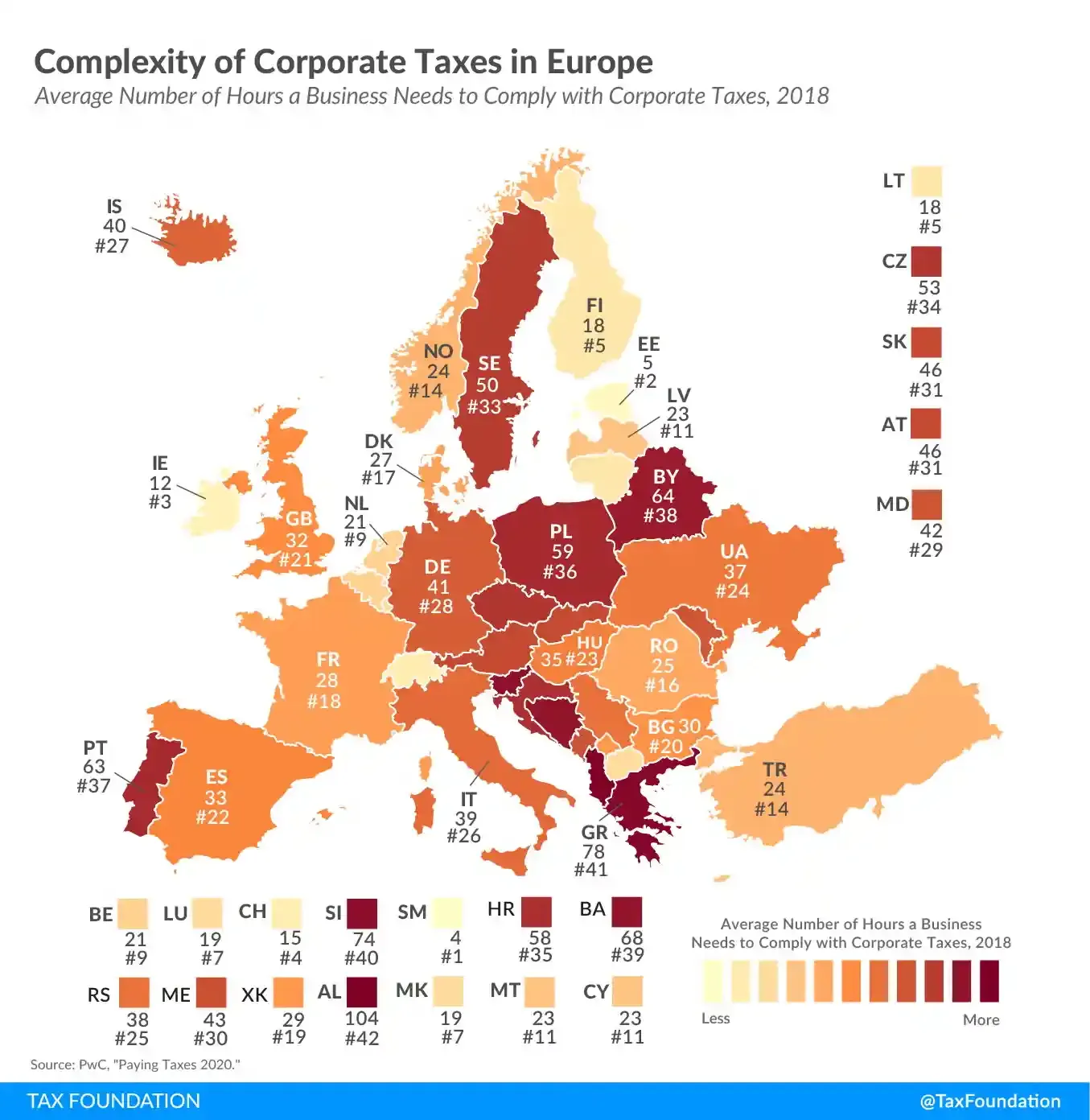
Estonia has no annual corporate tax return requirements; you only have to file monthly when you make distributions. According to the Tax Foundation, Estonian companies spend only 5 hours a year on corporate tax compliance, 32 hours less than the European average.
Annual Report
Every company, even dormant ones, must file an XBRL report via the Business Register. The data is public, which boosts transparency for investors but holds directors personally liable for late filing. A late report triggers a €200 automated fine; continued non-compliance can escalate to €3,200 and eventual strike-off.
VAT Registration and Filing
Obligatory when Estonian turnover exceeds €40,000 in a year, optional earlier. The 24 percent standard rate applies to most goods and services; hotels enjoy 13 percent, and books and medicines 9 percent. Returns are filed monthly. Instead of real-time SAF-T, Estonia is combining the KMD and INF forms into a single return with direct accounting integration by 2027.
Conclusion
The Estonian corporate tax model remains one of the most entrepreneur-friendly on the planet:
- 0 percent on retained profits - keep cash inside the company as long as you like.
- 22 percent on cash-outs - and only when you decide to hit the payout button.
- Digital by default - incorporate, file, and pay online from anywhere.
- Strong treaty network - 66 agreements and no dividend withholding.
- Stable rules - Parliament killed the 24 percent hike, locking the 22 percent Estonia corporate tax rate in place for 2026.
Whether you are a solo SaaS founder, a private-equity fund setting up a holding vehicle, or a multinational routing Nordic sales through Tallinn, Estonia offers predictability and an unmatched deferral tool to fine-tune your global effective rate.

Related publications
Explore related insights and legal updates, covering immigration, relocation, and cross-border mobility.

Estonia guards its nationality with Nordic seriousness, so every applicant must understand the long game that turns a residence permit into eventual citizenship.

A clear, practical guide explaining how Estonia’s tax system works for foreigners, including residency rules, income taxes, corporate taxation, and key benefits for expats.

A practical, up-to-date guide for Americans planning to relocate to Estonia, covering visas, costs, housing, jobs, and key steps for a smooth and legal move.

This guide explains what an OÜ is, what is required for registration, how the online process works, what taxes apply, and where founders usually face delays.

Discover how to obtain a digital nomad visa in Estonia step by step, from eligibility and document preparation to filing, tax considerations, and practical tips for a smoother approval process.

Estonia’s e‑Residency is one of the most innovative programs to come out of Europe in recent years.
Frequently Asked Questions About Estonia Corporate Tax
Is corporate tax in Estonia really 0%?
It is 0 percent only on profits you keep inside the company. Once you distribute, 22 percent applies. Many startups, therefore, operate for years without a tax bill.
How is Estonia corporate tax calculated?
Does e-Residency affect my corporate tax obligations?
What makes Estonia's corporate tax system unique compared to other EU countries?
What happens if I never distribute profits?

