
Cyprus Residency by Investment: A Complete 2026 Guide

I used their services for assistance with business-related immigration documents. Everything was handled professionally and communication was consistent. They were detail-oriented with paperwork, which honestly helped reduce a lot of stress. Overall, a solid experience without any major issues
Read on TrustPilot
I had a consultation with Bimaris Law Firm regarding immigration and tax questions connected to relocation. They were helpful and seemed knowledgeable in both areas, which saved me time looking for separate specialists. I appreciated the calm and professional approach. The whole experience felt smooth and well managed.
Read on TrustPilot
I've worked with Taras from Bimaris (formerly Intermarium) a few times now over the past few years. As a Canadian citizen, they handled my temporary residence permit on the basis of employment at my already-registered LLC. Everything was successfully handled in 2026, then in 2024. Recommended!
Read on TrustPilot
Working with the team was very easy. They were quick to respond to our questions and needs.
Read on TrustPilot
As in any country, negotiating immigration bureaucracy can be difficult. I am glad I used the services of Bimaris as they were professional and very supportive, advising me at every stage and managing the paperwork. Today, they accompanied me to the Immigration centre to ensure all went smoothly. I strongly recommend them to anyone looking for visa and immigration services in Ukraine.
Read on TrustPilot
I was supported throughout several stages of my immigration process, and they were always happy to provide initial consultation and costing for services without charge. I cannot fault my experience with them
Read on TrustPilot
Professional, reliable and reasonably priced. I would recommend them to my friends or clients if they need legal services in Ukraine.
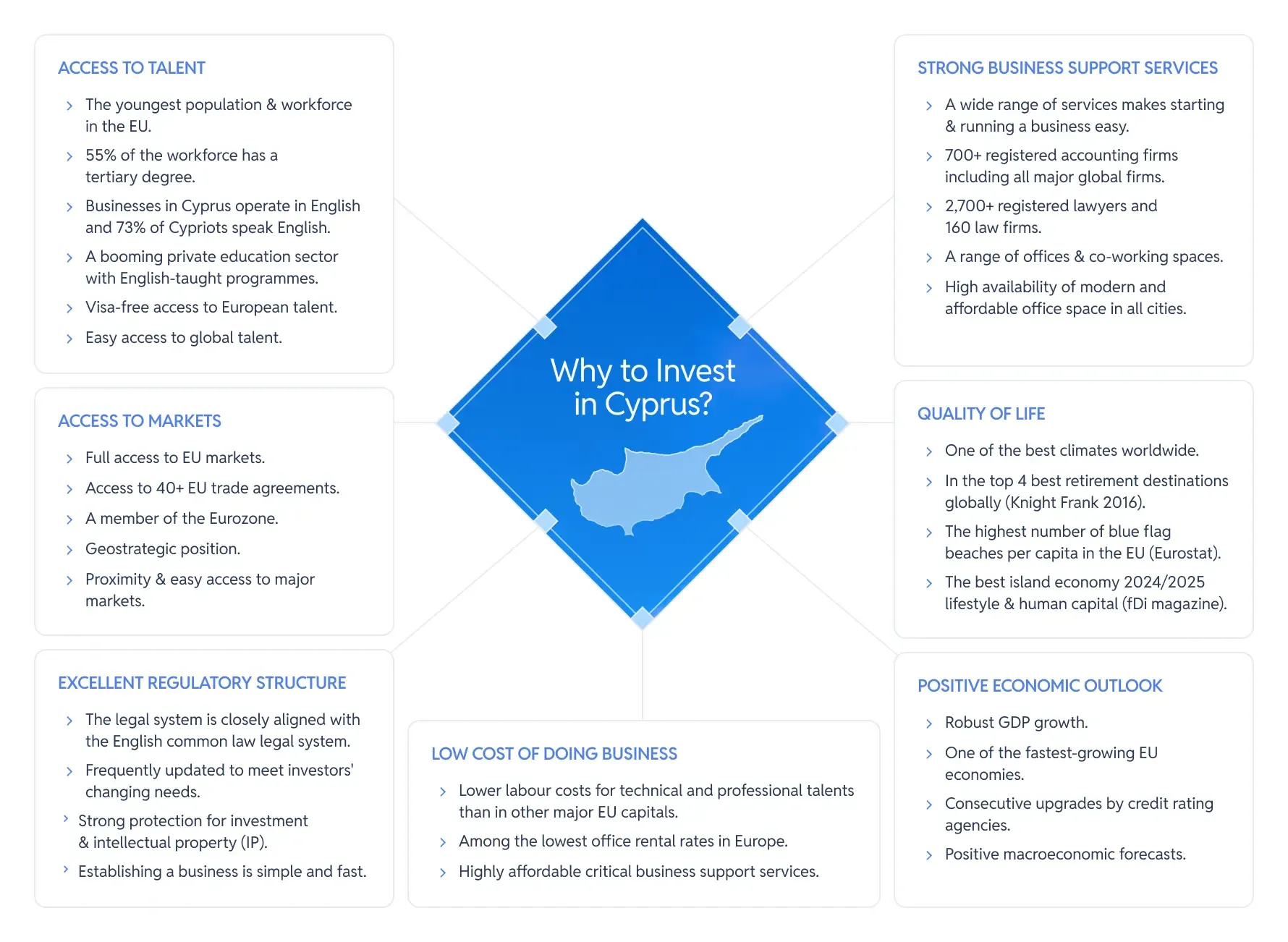
Read on TrustPilotCyprus has long occupied a sweet spot between Europe, the Middle East, and Africa, yet only in the past decade has it emerged as a go-to jurisdiction for strategic relocation. With English-language banking, common-law-compatible statutes, and 300 days of sunshine, the island offers a lifestyle that feels almost holiday-like even when you are technically “on-residence duty.” Even more compelling is Regulation 6(2), often called the Cyprus residency by investment program, which packages all those lifestyle perks into an immigration status that never expires.
This guide delivers everything a high-net-worth reader or internationally active entrepreneur needs to know about securing Cyprus residency by investment. We drill into qualifying asset classes, 2026 tax reforms, Schengen realities, and the hard numbers most marketing brochures skip. Read on to understand why the Cyprus golden visa remains one of the most efficient asset-diversification tools in Europe and how to avoid its hidden tripwires.
Ready to secure Cyprus permanent residency?
Get personalised guidance on the Cyprus residency-by-investment programme, eligibility requirements, and the best investment option for your goals.

What Is Cyprus Residency by Investment?
The scheme is formally Cyprus Permanent Residency under Regulation 6(2) of the Aliens and Immigration Regulations. In exchange for a €300,000 qualifying outlay, non-EU, non-EEA, and non-Swiss nationals receive an open-ended residency permit and the right to live, study, and own property in the Republic. It is not a quick passport - Cyprus scrapped citizenship-by-investment in 2020 - but unlike typical temporary visas, the permit never lapses as long as basic conditions are met.
Why does this matter to global investors? First, the card insulates families from political shocks at home by guaranteeing a European foothold. Second, the island’s flexible tax residency by investment in Cyprus rules mean you can cherry-pick when, or whether, to become a Cyprus tax resident. Third, holding PR unlocks a measured pathway to EU citizenship via naturalization, with none of the reputational baggage that doomed the golden-passport era.
In practice, the program is best viewed as a toolbox: real estate for those diversifying bricks-and-mortar, funds for investors who prefer liquidity, and corporate equity for founders building local payroll. Each route satisfies the €300,000 floor, but each carries different compliance nuances.
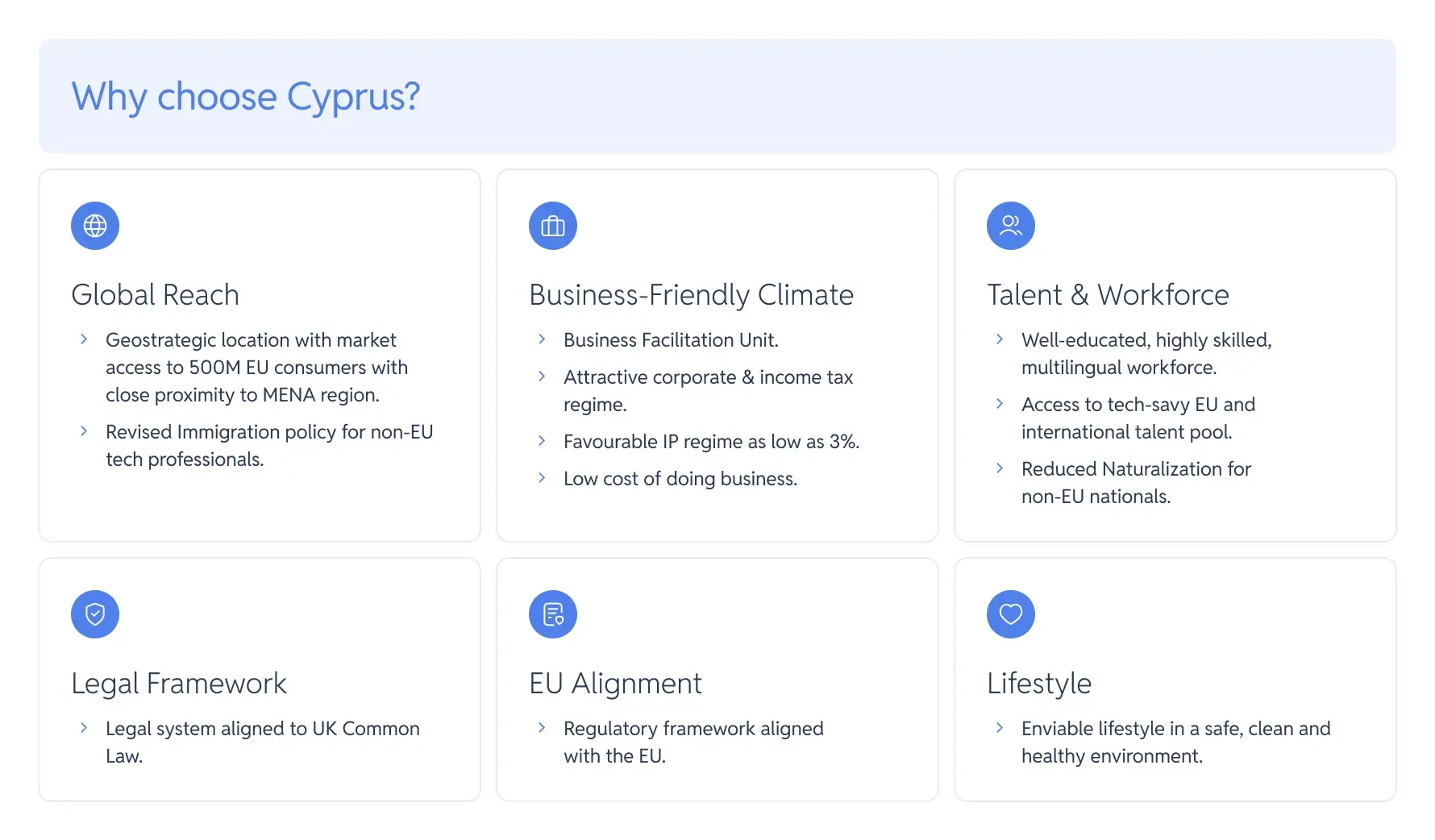
Investment Options Under the Cyprus Golden Visa
Before exploring the four asset classes, it helps to visualize how they compare. The table below distills the headline variables - minimum spend, VAT exposure, liquidity, and family-planning fit.
| Qualifying Asset | Minimum Net Spend | Eligible Examples | Pros | Cons |
|---|---|---|---|---|
| New Residential Property | €300,000 + VAT (19% or 5%) | First-sale apartments, villas, two units combined | Tangible asset, holiday use, 5% VAT on first 130 m² | Tied-up capital, resale homes disallowed |
| Commercial Real Estate | €300,000 + 19% VAT | Offices, shops, hotels, warehouses | Solid rental demand, resale units allowed | Tenant risk, market cycles |
| Shares in a Cyprus Company | €300,000 | Equity in CY company w/ ≥ 5 employees, real presence | Dividend upside, aligns with operating business | Active governance needed, no payroll for investor |
| Units in Cyprus AIF/RAIF | €300,000 | Regulated alternative investment fund | Professional management, diversified, liquid | Fees, NAV volatility, due-diligence critical |
New Residential Property
Cyprus's residential market rebounded strongly after the pandemic, though the pace has been uneven rather than a straight line up. Central Bank of Cyprus data show annual price growth cooling to around 4.5% by the end of 2024 - down from double-digit rates in 2022-23 - before reaccelerating again in late 2025 on renewed foreign and local demand. Fast-track rules insist on real estate bought brand-new from a developer. Resale apartments on the seafront in Limassol, however tempting, do not count. A buyer may split the spend between two first-sale properties, a strategy many use to secure both seaside living and a city pied-à-terre.
VAT strategy is crucial. The standard 19% rate inflates headline spend, yet a 5% concession applies on the first 130 m² of a principal residence if the total consideration remains under €475,000 and the buildable area is below 190 m². Because the relief is calculated on covered floor area rather than a flat euro threshold, the exact VAT split varies property to property, a point worth running past a tax adviser before signing, not estimating from a brochure. Investors aiming to occupy the property part-time often design layouts to fit inside that subsidy band. Note that any square meter beyond 130 m² reverts to 19% VAT, so professional architects and tax advisers must coordinate early.
Commercial Real Estate
Where residential buyers eye sunsets, commercial buyers fixate on yield. Grade-A office space in Nicosia and Limassol has shown the strongest rental growth of any commercial segment in recent RICS/KPMG property surveys, and warehousing tied to the island's maritime trade has held up well too, though headline yields are more modest than some marketing materials suggest and should be underwritten property-by-property rather than assumed. Because the CRMD allows secondary-market offices, investors can target stabilized assets with existing tenants rather than wait out construction. Enhanced liquidity comes at a cost: VAT is always 19%, and lease enforcement through Cyprus courts can take considerably longer than in other EU jurisdictions if a tenant dispute goes to litigation. Savvy landlords therefore vet tenant covenants rigorously or hire local asset managers.
Shares in a Cyprus Company
This route aligns immigration with business expansion. The investor injects €300,000 into share capital; the company must have a physical office in Cyprus and at least five Cypriot or EU employees. Many tech founders use the structure to open an R&D hub and leverage the island’s 2.5-3% effective IP Box rate on qualifying profits. Note, however, that the investor cannot draw a local salary; labor income must come from abroad or be deferred as dividends. Maintaining payroll and audited accounts is not optional - CRMD periodically checks that staff numbers stay above five.
Cyprus Investment Funds (AIF / RAIF)
The youngest but fastest-growing category is fund units. Cyprus-domiciled AIFs and RAIFs, supervised by CySEC, invest in ships, solar farms, credit strategies, or pan-European equities. Liquidity varies, yet most vehicles offer quarterly redemptions after an initial lock-up. This structure keeps capital mobile yet still qualifies for permanent residency in Cyprus by investment for investors who are cautious about property market fluctuations. A lawyer should read fund term sheets. Some charge 2% management fees plus 20% performance carry which eats into yield if NAV growth is single digit.
Eligibility Requirements for Permanent Residency in Cyprus by Investment
The headline numbers - €300,000 investment and €50,000 annual income, sound simple until documentation gets underway. “CRMD wants a paper trail all the way back to the source of the wealth, and if something doesn’t match up, it can stall files for months.
Investment and Income Threshold
Lead applicants must evidence at least €50,000 in annual income from legitimate sources such as salaries, dividends, pensions, or rental streams. Where the investment is in residential property, all income must originate outside Cyprus; for shares, commercial real estate, or funds, partial Cyprus-sourced dividends or lease income is acceptable. Spouses push the bar to €65,000 and each dependent child adds €10,000, meaning a family of four must show €85,000 flowing into their worldwide bank accounts annually.
Investors occasionally try to leverage crypto gains or unseasoned private-equity exits as income. CRMD does accept such sources, yet only if accompanied by notarized sale contracts and tax declarations from the jurisdiction where the gain was realized.
Source of Funds and Due Diligence
The phrase “clean criminal record” is deceptively short; in practice, it means ACRO certificates for UK citizens, FBI Identity History Summaries for US nationals, and equivalent clearance for each country where the applicant has lived over the past decade. Sanction checks also extend to family members above 14.
In addition, CRMD inspects the provenance of the €300,000. Expect to supply:
- Six months of bank statements.
- Contract of sale or share-subscription deeds.
- Company registry extracts if funds flow from a corporate dividend.
After submission, Bimaris Legal’s compliance desk often fields supplementary queries, so-called “clarifications,” from migration officers. Responding within the stated 30-day window preserves the file’s place in the fast-track queue.
Who Can Be Included as a Dependant
Cyprus is generous to university-age children: an unmarried son or daughter up to 25, enrolled full-time and financially dependent, rides on the same application. Yet the island is strict on parents and in-laws. They are barred from tagging along under Regulation 6(2). Families requiring three-generation coverage must investigate the slower self-sufficient residence route, which typically runs 12-18 months versus 6-9 months here.
Benefits of Cyprus Permanent Residency by Investment
Even after the 2026 tax increase to 15%, Cyprus wields several competitive edges.
Permanent Status With No Renewal
Most “golden visas” in Europe expire every two or five years. Greece demands renewal at five, Portugal at two. Cyprus issues an open-ended permit. Only the physical card must be reprinted every ten years, a process akin to renewing a driver’s license. That permanence turns capital expenditure into a one-time ticket instead of a recurring subscription.
Minimal Physical Presence
Cyprus requires a single visit inside each two-year window to preserve status. Many clients piggyback the flight on an annual board meeting or summer holiday, stepping into the Migration District Office to clock in, then flying out. Importantly, you choose when or whether to trigger tax residency. More on that in the Tax Benefits section.
Right to Rent Out Your Property
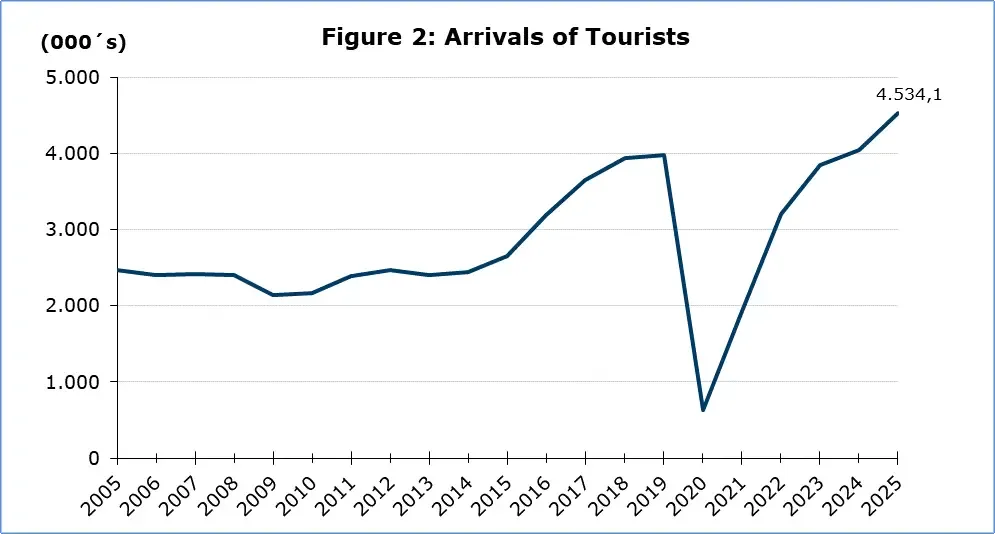
Rental yields on Cyprus property have hovered around 4.5-5.3% on average through 2025, with prime Limassol villas and apartments sitting at the top of that range - solid, if less dramatic than some brochures claim. The backdrop, though, has been genuinely strong: Cyprus logged a record number of arrivals of 4.53 million visitors.
PR holders may monetize property immediately, provided local rental contracts observe municipal licensing. Selling, however, is another story: you must either hold the asset or replace it with a fresh €300,000 qualifying investment to avoid permit revocation. Exit strategies therefore demand timeline mapping, especially for investors eyeing citizenship after eight years.
Path to EU Citizenship
Permanent residence can mature into a Cypriot passport through naturalization by residence. The eight-out-of-eleven calculus is straightforward but strict: time spent on the island counts day-for-day toward the tally, yet any year with fewer than 183 days of residence drops from the numerator. The final twelve months must be continuous, although absences up to 90 days for business or family emergencies are tolerated.
Cyprus’s Ministry of Education administers a basic Greek language and culture test. Candidates comfortable ordering coffee in Greek and explaining two key historical events, often the 1974 division and EU accession, tend to pass. Once citizenship is in hand, the new Cypriot also gains full Schengen mobility the very day Cyprus joins the Area, eliminating the visa tangle entirely.
Schengen Access - Current Status and 2026 Outlook
For now, your residency by investment Cyprus card does not grant borderless travel. Cyprus, like Ireland, sits outside the passport-free zone. The European Commission’s fifth State of Schengen report (May 2026) lists “complete Cyprus accession” as a priority for 2026-27. Technical readiness was achieved in 2025, yet EU Council unanimity remains, in diplomatic parlance, “under discussion,” mainly due to the island’s division.
Practically, that means investors still apply for Schengen visas when popping to Paris or Munich. Processing is simpler - your Cypriot PR bolsters “strong ties” evidence - but the visa sticker is still required. Any agent promising Schengen freedom on day one is recycling 2020 marketing brochures.
If and when accession clears the Council, all valid PR cards will double as Schengen stay authorizations up to 90/180 days, saving future trips to consulates. Bimaris monitors Brussels calendars and alerts clients the moment timelines firm up.
Tax Benefits
Non-Domicile Regime
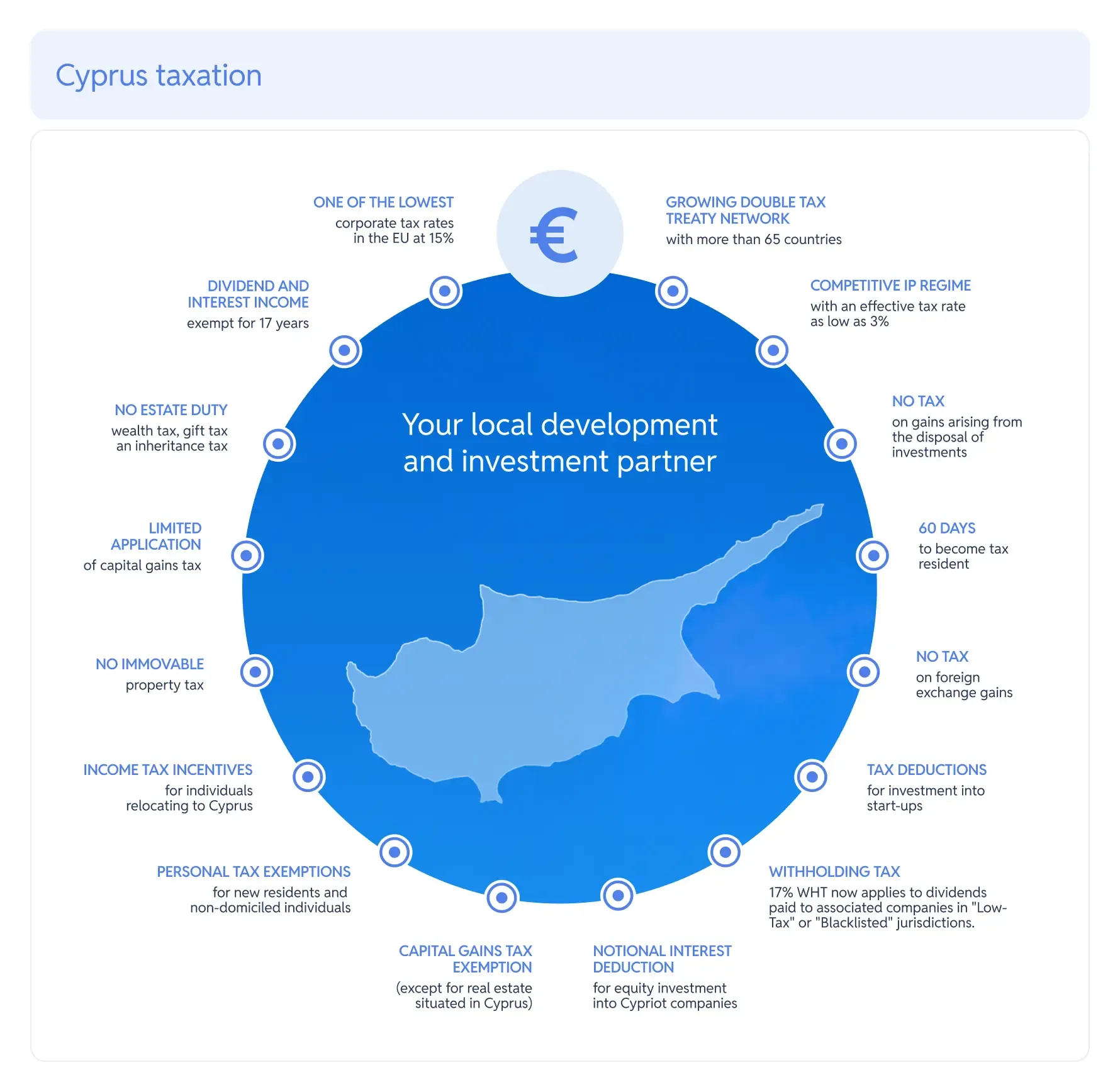
Upon electing Cyprus tax residence, a newcomer is almost automatically non-dom, provided they were not a tax resident for 17 of the past 20 years. Non-doms pay 0% Special Defence Contribution on dividends and interest. Given many PR applicants hold controlling stakes in offshore companies, routing dividends via Cyprus can slash effective personal taxation to the 2.65% National Health Contribution alone.
No Inheritance Tax, No Wealth Tax
Structuring for generational wealth is simpler here. Cyprus lifted inheritance tax in 2000 and, following 2026 reforms, abolished stamp duty entirely, reducing asset transfer friction. Capital gains tax applies only to immovable property situated in Cyprus or shares of companies owning that property, not worldwide securities.
The 60-Day Tax Residency Rule
The headline 60-day rule out-trumps Malta’s 183-day threshold. Achieving it requires:
- 1Spacing fewer than 183 days in any other single jurisdiction,
- 2Owning or renting a Cyprus residential address,
- 3Holding a directorship or employment contract with a Cyprus entity, and
- 4Declaring that you are not tax resident elsewhere.
The beauty: PR holders can remain non-tax residents indefinitely or dip in for exactly 60 days to unlock non-dom perks when dividend distributions spike. Bimaris Legal frequently models 20-year projections to decide when flip-ping residency makes sense.
15% Corporate Tax
Cyprus lifted its headline corporate rate to 15% on 1 January 2026, aligning with OECD Pillar Two. The rate is flat, transparent, and still pairs with various reliefs: an 80% exemption on qualifying IP Box income (effective 2.5-3%), 0% withholding on outbound dividends, and full participation exemptions on foreign capital gains. Compared to Germany’s 30% or France’s 25%, startup founders still pocket meaningful arbitrage.
Total Costs
Calculating cash outflow is more than multiplying €300,000 by 1.19. Below is a realistic cost matrix for a family of four buying a €350,000 new apartment intended as a holiday base:
| Cost Item | Basis | Amount |
|---|---|---|
| Purchase Price | €350,000 | €350,000 |
| VAT (5%/19% blended, based on covered floor area – illustrative example assumes a property modestly over the 130 m² reduced-rate threshold) | €350,000 | ~€24,000 |
| PR Application Fees | €500 × 4 | €2,000 |
| Residence Cards | €70 × 4 | €280 |
| Medical Insurance | €170 × 4 | €680 |
| Legal & Land Registry | Fixed estimate | €17,000 |
| Total Cash Outlay | — | ~€394,000 |
Stamp duty would have added roughly €600 on a purchase this size before its abolition in 2026, illustrating why up-to-date guidance matters. Maintenance costs - community fees, insurance, and property tax (Cyprus abolished its national immovable property tax back in 2017, so only small municipal fees remain) - run €2,500-€3,000 annually and should be factored into ROI modeling.
How to Apply for Cyprus Residency by Investment: Step by Step
The Cypriot paper-trail culture is detail-oriented; missing one apostille can waste weeks. The timeline below assumes proactive compliance and funds ready to transfer.
- Step 1
Legal Consultation and Eligibility Check
The work starts with a 60-minute Zoom where counsel interrogates the family tree, sources of income and exposure to sanctions. Bimaris Legal’s compliance questionnaire spans 28 items, including PEPS checks and Ultimate Beneficial Owner charts. Identified gaps are patched before money moves.
- Step 2
Investment and Property Purchase
Once the green light flashes, investors reserve the asset usually via a 10% deposit. Property contracts are lodged at the Department of Lands and Surveys; fund subscriptions close with escrow confirmation; and share issues are filed with the Registrar of Companies. A minimum €200,000 must clear into Cyprus before application lodgement.
- Step 3
Document Preparation
The PR dossier often tops 120 pages. It includes notarized and translated passports, marriage certificates, birth certificates, sealed police clearances, University enrolment letters (for 18-25-year-olds), bank reference letters, property contracts, and the MIP2 application form. Apostilles under The Hague Convention authenticate foreign public documents.
- Step 4
Submission to the CRMD
Files are couriered or hand-delivered to the Civil Registry and Migration Department in Nicosia. Interim arrivals are allowed with the file number receipts if the family wishes to settle earlier.
- Step 5
Processing
Fast-track review takes on average six to nine months. The backlog eased in late 2025 after CRMD digitized records. Applicants may check status via an e-portal using their file number and passport.
- Step 6
Biometric Visit and PR Card Issuance
Approval triggers an invitation to collect biometrics - fingerprints, signature, photo - at district offices. Cards print in roughly four weeks. Counsel escorts families to ensure location rules (no sandals, passport originals mandatory) are observed. Cards are valid for ten years and then renewed in ten-minute appointments.
After card collection, Bimaris Legal calendars the two-year visit reminders and handles annual income affirmation letters, ensuring the PR never lapses.
Conditions and Restrictions of the Cyprus Golden Visa Program
Cyprus’s regimen is liberal but not laissez-faire. Understanding boundaries prevents costly mistakes.
First, PR does not confer employment rights. A holder may sit as an unpaid director or shareholder, yet cannot sign a Cypriot employment contract. Violations surface quickly because payroll systems feed social insurance data directly to the Ministry of Labour.
Second, the €300,000 investment (or its approved replacement) must stay in place. Attempting to sell the qualifying apartment after an opportunistic price spike, without reinvesting, will flag during CRMD’s random audits. A revocation notice typically gives 30 days to cure the breach by purchasing another qualifying asset or topping up fund units.
Third, the two-year physical-presence rule is a statutory requirement, not a guideline. Passport stamps and electronic border entries are cross-checked; missing the deadline by even a week obliges a fresh application from scratch.
Adult dependants lose coverage if they marry, turn 26, or exit full-time studies. Parents need their own route. Keeping a compliance calendar curated by professionals avoids unpleasant surprises.
From Residency to Citizenship - The Cyprus Pathway
The shift from PR holder to Cypriot national is a marathon, yet the prize is substantial: a passport that grants full EU mobility and - post-accession - automatic Schengen freedom. Residency counts only when actually spent in-country, so many investors alter travel routines from year five onward to accumulate the eight qualifying years. A typical strategy: block two summer months and a winter month in Cyprus annually, totalling around 210 days each calendar year. By year eight you have the residence days banked and can commence the continuous final twelve-month stretch, with no single absence exceeding 90 days.
During the citizenship process, applicants file a naturalization form, supply Greek Language Certificate B1, and pass an interview on Cypriot history. Processing currently ranges 12-18 months. Because the old passport-for-cash scheme ended in ignominy, today’s naturalized citizens face no stigma; the route is transparent and compliance-oriented.
How Bimaris Can Help
Regulation 6(2) might read like a single page in the Gazette, but executing its requirements crosses corporate, real-estate, fund, and tax law. Bimaris Legal offers an end-to-end solution:
- Investment Matching - Through relationships with licensed developers, CySEC-regulated fund managers, and vetted corporate service providers, the firm curates assets that fit risk appetite and holding-period goals.
- Source-of-Funds Dossier - A compliance team collates bank evidence, apostilles, and affidavits, cutting average clarification requests by 70%.
- Tax Optimization - In-house chartered accountants model when to become a non-dom tax resident and the benefits of a non-dom tax resident, comparing 60-day versus 183-day formulas.
- Lifecycle Support - Services go beyond issuing cards to include annual income filings, property tax returns and ultimately naturalization paperwork eight years later.
Because the 2026 corporate-tax rise and stamp-duty abolition reshaped financial forecasts, Bimaris Legal recalibrates client models monthly. The objective is clarity: know the rules, play within them, and exit when the strategy calls for it.
Conclusion
The Cyprus residency by investment landscape in 2026 is neither a loophole nor a marketing gimmick; it is a codified, regulator-policed path to an EU foothold that has survived political change precisely because it offers value without compromising integrity. For €300,000 - cheaper than a London flat deposit - investors secure lifetime residency, a springboard to citizenship, and the option (not obligation) to plug into one of Europe’s friendliest tax regimes.
Missteps happen when applicants treat the process as a formality. It is not. Source-of-funds narratives must align line-by-line; asset replacements must be pre-cleared; and Schengen promises must be grounded in present reality, not aspirational press releases. Engage advisers who live and breathe the regulations, and Cyprus can be far more than a holiday destination; it becomes an insurance policy, a tax playbook, and a genuine second home.
Ready to secure Cyprus permanent residency?
Get personalised guidance on the Cyprus residency-by-investment programme, eligibility requirements, and the best investment option for your goals.

Related publications
Explore related insights and legal updates, covering immigration, relocation, and cross-border mobility.

Our immigration experts will help you choose the most cost-effective European residency programme for your personal and financial goals.

The Italy Digital Nomad Visa gives non-EU remote professionals a legal route to live in Italy while working online.

Permanent residency is the next logical step once you have tested the continent on short-term visas and decided you want a stable base.

The Portugal digital nomad visa (D8) lets remote workers live in the country while earning income outside. Applicants qualify as remote employees, freelancers, contractors, or business owners.

Croatia’s Digital Nomad Visa lets remote workers live legally in Europe for up to 18 months while working for foreign clients or companies tax-efficiently.

A concise overview of the European Union Migration Pact, explaining the new migration and asylum rules and how they will affect moving to Europe from 2026.
Frequently Asked Questions
Can I work in Cyprus with permanent residency?
No. Regulation 6(2) PR does not authorize paid employment. You may own shares and receive dividends but cannot hold a local employment contract.
Can I sell my investment property after getting PR?
Does Cyprus PR give Schengen travel rights?
How long does the application take in 2026?
Can I include my parents in the application?
Is the Cyprus Golden Visa program still active in 2026?

